
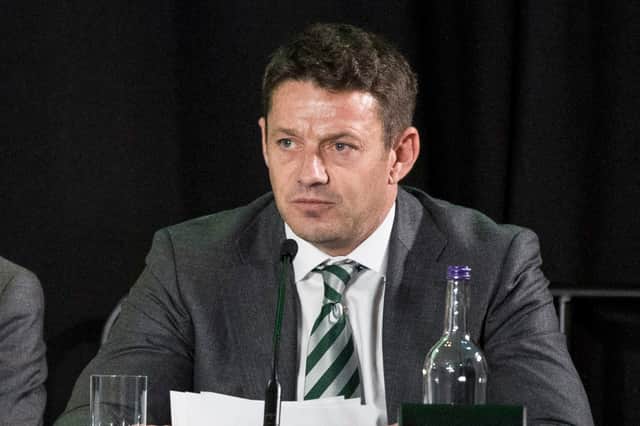
The Celtic Trust is attempting to force the club board to apologise for allowing Ross Desmond to launch an “egregiously insulting and offensive tirade” against supporters.
The supporters’ group is looking for backing among shareholders for three resolutions at the club’s next annual general meeting, which is expected to take place later this year.
Trust Pushes Three Key Resolutions
The Celtic Trust owns about a 0.2 per cent stake in the club, with its shareholding worth about £350,000.
The group has called for Celtic chairman Brian Wilson to make a “full and unreserved apology to shareholders and supporters” for giving Desmond the chance to hit out at critics on behalf of his father, principal shareholder Dermot Desmond, at last year’s AGM.
A statement read: “As we understand it, he was attending the AGM as a proxy for a relative of his and was, as we all are, entitled to speak at the appropriate time and in the appropriate part of the hall.”
The Platform That Sparked Outrage
“However, from his unwarranted and elevated position, Mr Desmond delivered a tirade against the support which was so egregiously insulting and offensive that the response of shareholders was clearly audible in the hall.”
Ross Desmond hit out at “destructive and cynical” criticism of Celtic executives and accused some fans of being “bullies”, before then-chairman Peter Lawwell abandoned the meeting amid shouts from the floor.
The Celtic Trust statement added: “This was a complete abuse of the AGM process, should never have been allowed to happen, and should never be allowed to happen again.”
Calls for Accountability Grow Louder
“In a period of lows, this was amongst the lowest the Celtic PLC board have ever stooped and each and every one of them should be ashamed of themselves. We call on them to apologise so that we can put this shameful event behind us and move on.”
The Trust also called for the publication of a strategic plan, “not a wish list”, including stadium redevelopment proposals, and a review of security operations in co-operation with elected supporter representatives.
This proposed resolution claimed that security measures had been stepped up since the appointment of Mark Hargreaves, a former Police Scotland chief superintendent, as head of safety, security and operations.
Security Culture Under Scrutiny
A statement added: “This all feeds into the central concern: that Celtic has placed too much faith in a policing-led model of supporter management, and in doing so has created a security culture focused on surveillance, restriction and control rather than protection, engagement and trust.”
The publication of the proposed resolutions came amid a further deterioration in relations between Dermot Desmond and a section of fans.
A Celtic statement on Saturday claimed some supporters had “brought shame upon the name” of the club after they threw tennis balls towards the 76-year-old Irishman as he played alongside five-time major winner Brooks Koepka in the Alfred Dunhill Links golf tournament at St Andrews.
On-Pitch Form Offers Contrast to Off-Field Tension
While the boardroom battle intensifies, Celtic currently sit top of the Scottish Premiership after seven matches.
Martin O’Neill’s side have taken 18 points from a possible 21, recording six wins and one defeat.
They lead Rangers by two points, having scored 14 goals and conceded just four.
Recent Results Shape the Mood
A recent 0-1 home defeat to Rangers still stings for many supporters.
That reverse, combined with an earlier League Cup exit to the same opponents, has sharpened scrutiny of the club’s direction.
Yet the overall league picture remains strong, with Celtic clear favourites to retain their title.
Fan Frustration Runs Deeper Than Results
Many supporters argue that domestic dominance masks deeper problems.
European progress has been limited this season, with the team dropping into the Europa League league phase after exiting the Champions League at the play-off stage.
That early continental exit has fuelled ongoing debates about recruitment and long-term strategy.
Trust Demands Concrete Planning
The Celtic Trust’s call for a detailed three-to-five year strategic plan reflects these concerns.
Supporters want clarity on stadium redevelopment, squad investment, and how the club intends to compete more consistently in Europe.
They insist the plan must go beyond vague aspirations and deliver measurable targets.
Security Model Divides Opinion
The proposed review of security operations has also struck a chord with sections of the support.
Critics of the current approach argue that the emphasis on control has damaged the matchday atmosphere at Celtic Park.
They want greater involvement of elected fan representatives in shaping future policies.
A Club Divided on Engagement
Relations between the board and organised supporter groups have been strained for some time.
The tennis ball protest at St Andrews marked a new low in the relationship with principal shareholder Dermot Desmond.
Celtic’s strongly worded response underlined how far trust has eroded.
What Happens Next at the AGM
The three resolutions will only proceed if they gather the required 100 shareholder signatures.
Even then, the board’s significant voting power means formal approval is far from guaranteed.
Yet the Trust believes the process itself will force greater accountability and public debate.
Brian Wilson in the Spotlight
Interim chairman Brian Wilson now finds himself at the centre of the storm.
He has been tasked with steadying the ship following Peter Lawwell’s departure from the role.
Supporters will be watching closely to see how he responds to the demand for a formal apology.
Broader Context of Supporter Power
Celtic fans have long prided themselves on their ability to influence club decisions.
The Trust’s intervention continues that tradition of organised pressure.
Whether it produces meaningful change remains to be seen.
Tactical Questions Linger Too
On the pitch, O’Neill continues to refine his preferred system.
The side has looked solid defensively for long stretches but has occasionally struggled to break down compact opponents.
Creating consistent chances against lower-table teams remains a work in progress.
Looking Ahead to a Critical Period
The coming weeks will test Celtic on multiple fronts.
League fixtures continue thick and fast, while European commitments demand careful squad management.
Off the pitch, the AGM resolutions ensure the board cannot simply ignore the growing discontent.
For many fans, the demand for an apology is about more than one speech.
It represents a wider call for respect, transparency, and a genuine partnership between those who run the club and those who sustain it.
As the Trust seeks the necessary signatures, Celtic Park remains a place of both fierce loyalty and unresolved tension.
How the board chooses to answer will shape the atmosphere around the club for months to come.