
“I Don’t See What This Celtic Team Is Trying to Do” – Kris Boyd’s Damning Verdict After Shock Falkirk Defeat
Celtic’s season took another unexpected and deeply concerning turn on Sunday afternoon as Martin O’Neill’s side slumped to a 2-0 defeat against Falkirk at the Falkirk Stadium.
What should have been a routine away victory for the league leaders instead became a painful reality check.
Goals from Ethan Ross in the third minute and Scott Tanser before half-time handed the Bairns a famous win – their first over Celtic in 19 years – and left the champions looking short of ideas, energy and, most damagingly, a clear identity.
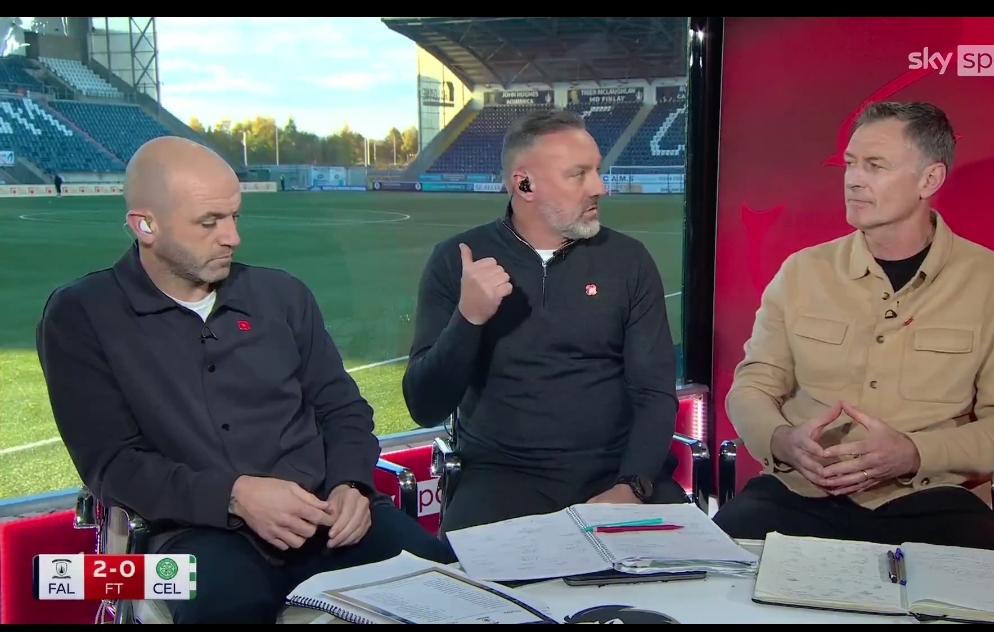
The result itself was bad enough. The post-match analysis on Sky Sports Scotland made it considerably worse.

In a frank and uncomfortable discussion, Kris Boyd, James McFadden and Chris Sutton tore into Celtic’s current direction. Boyd’s comments in particular cut through the usual post-match politeness with surgical precision.
“We can say all we want about Wilfried Nancy, but you could see what he was trying to do,” the former Rangers striker said. “I don’t see what this Celtic team is trying to do.”
Those two sentences have already sparked intense debate among supporters. They capture a growing sense of unease that has been building around Celtic Park for several weeks.
Results have largely held, and Celtic remain top of the Scottish Premiership, but the manner of performances has left many questioning exactly what the plan is under Martin O’Neill.
A Shock Result That Felt Inevitable
Falkirk arrived at the game in excellent form, sitting in the upper half of the table after a strong start to life back in the Premiership.
They had won their previous three matches and approached the contest against Celtic with real belief and organisation. Celtic, by contrast, looked flat from the opening whistle.
The opening goal arrived inside three minutes and set the tone for the afternoon. A cross into the box was not dealt with cleanly by Cameron Carter-Vickers, and Ethan Ross pounced to fire home.
It was a soft goal by Celtic’s standards and handed the home side the confidence they needed. From that moment, Falkirk defended with discipline and broke with purpose. Former Celtic goalkeeper Scott Bain produced a string of important saves to frustrate the visitors, while the home defence stood firm against wave after wave of incomplete attacks.

The second goal, scored by Scott Tanser in the 38th minute, effectively ended the contest as a competitive spectacle. A well-worked move cut through Celtic’s midfield and defence far too easily, leaving Tanser with a clear sight of goal. He finished clinically. Celtic dominated possession and recorded more shots, but the quality of their play never matched the quantity. Too many attacks broke down in the final third. Too many passes went sideways or backwards. There was little urgency, even less creativity, and almost no clear pattern of play that suggested a settled system.
By full-time the scoreline read 2-0 to Falkirk. Celtic had been out-thought and, in key moments, out-fought. The defeat left them still top of the table but with the gap to Rangers narrowed and questions mounting about the direction of the team.
Boyd’s Brutal Assessment Hits Home
In the Sky Sports studio, the analysis was unsparing. Kris Boyd, never one to soften his opinions for the sake of diplomacy, went straight to the heart of the issue. His comparison with Wilfried Nancy was particularly pointed. Nancy’s time at Celtic was brief and unsuccessful. Appointed in December 2025, the Frenchman lasted just 33 days before being dismissed in early January 2026 after a run of poor results that included heavy defeats and a League Cup final loss. His win percentage was among the lowest in the club’s modern history.
Yet Boyd’s point was not that Nancy should have been retained. It was that, for all the problems during that short spell, supporters and observers could at least identify what the manager was attempting to implement. Nancy arrived with a clear reputation from MLS for proactive, possession-based, attacking football. The players struggled to adapt quickly enough, results collapsed, and the experiment ended. But the intention was visible.
“You could see what he was trying to do,” Boyd repeated. The same cannot be said of the current Celtic side, he argued. There is no obvious stylistic signature. The team does not press with consistent intensity. It does not dominate the ball in a structured way. It does not transition quickly or create overloads in wide areas with any regularity. Instead, performances often feel reactive, fragmented and lacking in clear purpose.
James McFadden and Chris Sutton largely agreed. Both questioned what the long-term plan actually is. Sutton, a former Celtic striker who knows the club’s expectations better than most, expressed frustration at the lack of a coherent approach. McFadden highlighted the absence of a recognisable pattern of play that players and supporters can buy into. Between them, the three pundits painted a picture of a team that is drifting rather than progressing.
The Context of Martin O’Neill’s Return
Martin O’Neill’s second spell as Celtic manager began in difficult circumstances. After Brendan Rodgers’ departure in late 2025, O’Neill stepped in as interim and stabilised the side. When Nancy’s short reign ended, the club turned back to the experienced Northern Irishman. He delivered a domestic double in the remainder of the 2025-26 season and restored a sense of order. Few would argue that his return was anything other than a success in the short term.
This season, however, the challenges have multiplied. The squad has been disrupted by injuries at key moments. The intensity of competing on multiple fronts has taken its toll. And the tactical approach has at times appeared cautious, prioritising control and minimising risk rather than imposing a clear attacking identity. Against stronger or well-organised opponents, that caution has sometimes tipped into passivity.
The Falkirk performance was the clearest example yet. Celtic enjoyed the majority of the ball but created little of genuine quality. There was no sustained pressure that forced Falkirk into repeated errors. When the home side sat deep, Celtic lacked the combination play, movement and cutting edge required to break them down. When opportunities to counter presented themselves, the transitions were often slow and predictable.
This is not to suggest that O’Neill has suddenly become a poor manager. His track record at Celtic and elsewhere speaks for itself. But the demands at Parkhead are unforgiving. Supporters expect not only results but a style of play that reflects the club’s traditional values of attacking, progressive football. When that style is missing, even solid league positions can feel unsatisfying.
Wilfried Nancy’s Brief and Troubled Reign
Boyd’s reference to Nancy was clever because it forced a comparison that many had avoided. Nancy arrived with an impressive CV from North America. He had won the MLS Cup with Columbus Crew and built a reputation for attractive, high-possession football. Celtic’s hierarchy clearly hoped he would bring a modern, progressive style to the club.
Instead, the transition proved too abrupt. Results deteriorated rapidly. Defeats to Hearts, Roma, St Mirren in the League Cup final and others followed. Players appeared uncertain in their roles. The system that had worked in MLS did not translate quickly enough to the physicality and pace of the Scottish game and European competition. After just over a month, the board acted.
In isolation, Nancy’s record looks poor. Yet Boyd’s observation holds weight. There was a discernible idea behind the approach, even if the execution failed. The same cannot currently be said with confidence about Celtic under O’Neill. The team wins more often than it loses, but the “how” remains elusive. That absence of clarity is what appears to be troubling the Sky Sports panel and a growing section of the support.
What This Means for the Title Race
Celtic remain in a strong position at the top of the Premiership. A four-point lead, even with a game more played than Rangers in some calculations, still represents a healthy cushion at this stage of the season. However, the manner of recent performances has handed momentum to their closest challengers. Rangers will sense an opportunity. Other clubs will approach matches against Celtic with increased belief that the champions can be frustrated and, on their day, beaten.
Falkirk’s victory will also give encouragement to every side in the bottom half of the table. If a well-organised, hard-working team can nullify Celtic’s attacking threat and punish individual errors, then others will attempt the same blueprint. The champions must find answers quickly if they are to prevent a series of difficult afternoons.
The next few fixtures will be revealing. O’Neill and his staff will need to restore sharpness in the final third, improve defensive concentration in the opening phases of matches, and, most importantly, establish a clearer tactical identity that players can execute with confidence. Without that, the questions raised by Boyd, McFadden and Sutton will only grow louder.
Identity Has Always Mattered at Celtic
Celtic’s most successful periods in the modern era have been defined by clear footballing identities. Under Martin O’Neill in his first spell, the side was powerful, organised and capable of moments of real quality. Under Gordon Strachan there was a more technical, possession-oriented approach. Neil Lennon’s teams often played with high intensity and directness. Ronny Deila experimented with a pressing style. Brendan Rodgers brought structured, patient build-up play and high standards of possession. Ange Postecoglou then transformed the club with an aggressive, high-risk, high-reward philosophy that captured the imagination of the support.
In each case, supporters could describe the team’s style in a few sentences. That clarity created belief and connection. When results dipped, the underlying idea still offered hope that improvement was possible. The current side appears to lack that defining characteristic. It is competent without being compelling, organised without being proactive, and successful without being convincing.
This is the core of Boyd’s criticism. Results can paper over cracks for a time. Eventually, though, the absence of a clear plan becomes visible, especially on days when the opposition refuses to be overawed. Falkirk refused. They executed their game plan with discipline and belief. Celtic, for all their superior resources and individual quality, could not impose theirs – largely because it remains unclear what that plan actually is.
Looking Ahead
Martin O’Neill has faced bigger challenges in his career and emerged successfully. He retains the confidence of many inside the club and a significant portion of the support who value his experience and man-management. The squad still contains quality across most positions. The league position remains favourable.
Yet the conversation has shifted. It is no longer only about collecting points. It is about the manner of those points and the longer-term direction of the team. Kris Boyd’s comments on Sky Sports simply articulated what a growing number of observers have been thinking. You could see what Wilfried Nancy was attempting, for better or worse. With the current Celtic team, too many people are struggling to see any clear intention at all.
Until that changes, afternoons like the one at Falkirk will remain a threat. And the questions from the television studio will continue to echo around Celtic Park. The champions still have time to provide answers. The clock, however, is ticking louder than it was a month ago.
Celtic’s response over the coming weeks will determine whether this defeat is remembered as a temporary blip or the moment when deeper concerns about identity and direction became impossible to ignore. For now, the verdict from the Sky Sports panel is clear, uncomfortable, and difficult to dismiss. The team that once prided itself on having a recognisable way of playing currently looks short of one. And in Scottish football, that is rarely a sustainable position for long.